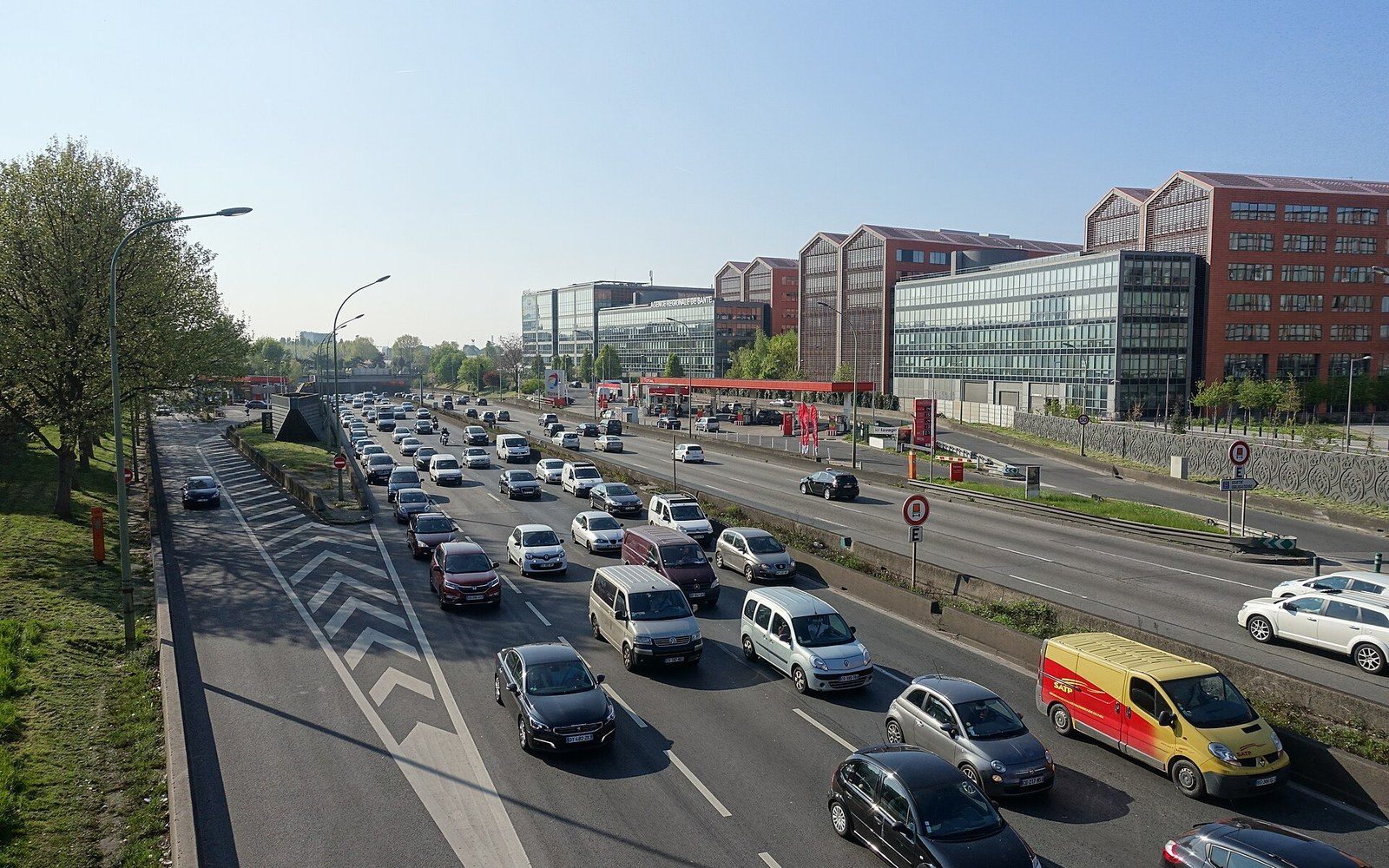
The périphérique is thirty-five kilometres of concrete, and the line it draws is not just about traffic.
A ring road that decides who is inside
The road and the word
Paris ends where the périphérique runs. That is the administrative fact: the boulevard périphérique — the inner ring road completed in 1973 — traces almost exactly the boundary between Paris the commune and the rest of Île-de-France. Inside it is the city as most people picture it: arrondissements, the Seine, Haussmann's boulevards. Outside it is immediately something else — Boulogne-Billancourt, Saint-Denis, Montreuil — places that are not Paris on any map, regardless of how seamlessly the buildings continue.
The word that matters once you live here is intra-muros, literally "within the walls." It appears in property listings, in job advertisements specifying a commute, in invitations that distinguish between a dinner in Paris and one "just outside." It refers technically to the twenty arrondissements within the périphérique, but it functions socially as a marker of a particular kind of centrality. To say something is intra-muros is to say it is fully in. The implication, rarely stated, is that everything beyond the ring road is not quite.
This matters more than it sounds. The périphérique is not an ancient moat or a medieval wall. It is a 1970s motorway, built on land that had previously held the old fortifications demolished after the First World War. The city's formal boundary was fixed at that line in 1860, when Haussmann's annexations absorbed the surrounding communes. Since then the city has not expanded. Paris the commune — the basic unit of French municipal government — covers just over a hundred square kilometres, which makes it smaller than many cities that nobody would describe as compact. The périphérique merely follows the crease that history left there.
What the boundary does in daily life
The practical consequences accumulate. A restaurant described as being in Paris may be walkable from a Métro stop that surfaces in Vincennes or Pantin — technically outside, which to a newcomer is invisible until it matters for a cab fare, a delivery zone, or a dinner conversation. Emergency services, planning rules, local taxation and the authority of the mairie — the town hall — all change the moment you cross the ring road, even where the street continues without a gap. In Saint-Denis, just north of the périphérique, you are in a separate commune with its own elected mayor, its own budget, and its own relationship with the préfecture of Seine-Saint-Denis. The infrastructure looks continuous; the administration is not.
The road itself is one of the busiest urban motorways in Europe, carrying well over a million vehicle movements on a weekday and famous for the absence of a hard shoulder on most of its length. It runs at the level of the surrounding streets in some sections, sunk below them in others, and passes through tunnels under the Bois de Boulogne. Noise from it is a fact of life for residents of the inner arrondissements whose windows face outward; the question of closing it to through traffic, or capping its speed, has been contested by successive municipal administrations and is unlikely to be resolved quietly.
What does not resolve quietly, either, is the social weight the word intra-muros carries. France is a country whose administrative geography is organised into communes, départements and régions, each with distinct powers and histories, and Paris sits inside that structure as a peculiarity: for most of the twentieth century it was simultaneously a commune and a département, governed by a prefect appointed by the state rather than an elected mayor. That arrangement ended in 1977, when Paris elected its first mayor in over a century. The boundary was not moved. The ring road stayed where it was. The terminology stayed with it.
Move here and you will find that where you live relative to the périphérique is information that people file away. It shapes expectations about commutes, about which boulangerie — bakery — is nearby, about whether you are the person hosting or the person travelling. The road was built to manage traffic. What it manages, just as thoroughly, is how people imagine the city's inside and outside — and those two things are not always the same place.